BananaSight: Satellite Early Warning for Fusarium Wilt TR4
A Sentinel-2 monitoring system that learns the banana growth cycle across 713 annotated Lebanese fields and flags stressed plants, including Fusarium wilt TR4, so growers can target inspection before damage becomes irreversible.
EBRD Innovation Programme in Lebanon · Agriculture · TR4 · 2025
The problem
Fusarium wilt Tropical Race 4 (TR4) is a soil-borne fungal pathogen with no chemical treatment and no cure. It attacks Cavendish bananas, the genetically uniform variety behind almost all internationally traded fruit, and it persists in soil for decades, so an infected field cannot simply be replanted. Because plantations are propagated vegetatively, every plant in a block shares the same susceptibility, and once TR4 arrives it can spread rapidly within a field. Prevention, containment and early detection are the only viable defences, and conventional field monitoring is labour-intensive, irregular, and tends to find infections only at an advanced stage, when containment is no longer practical.
The programme and the study area
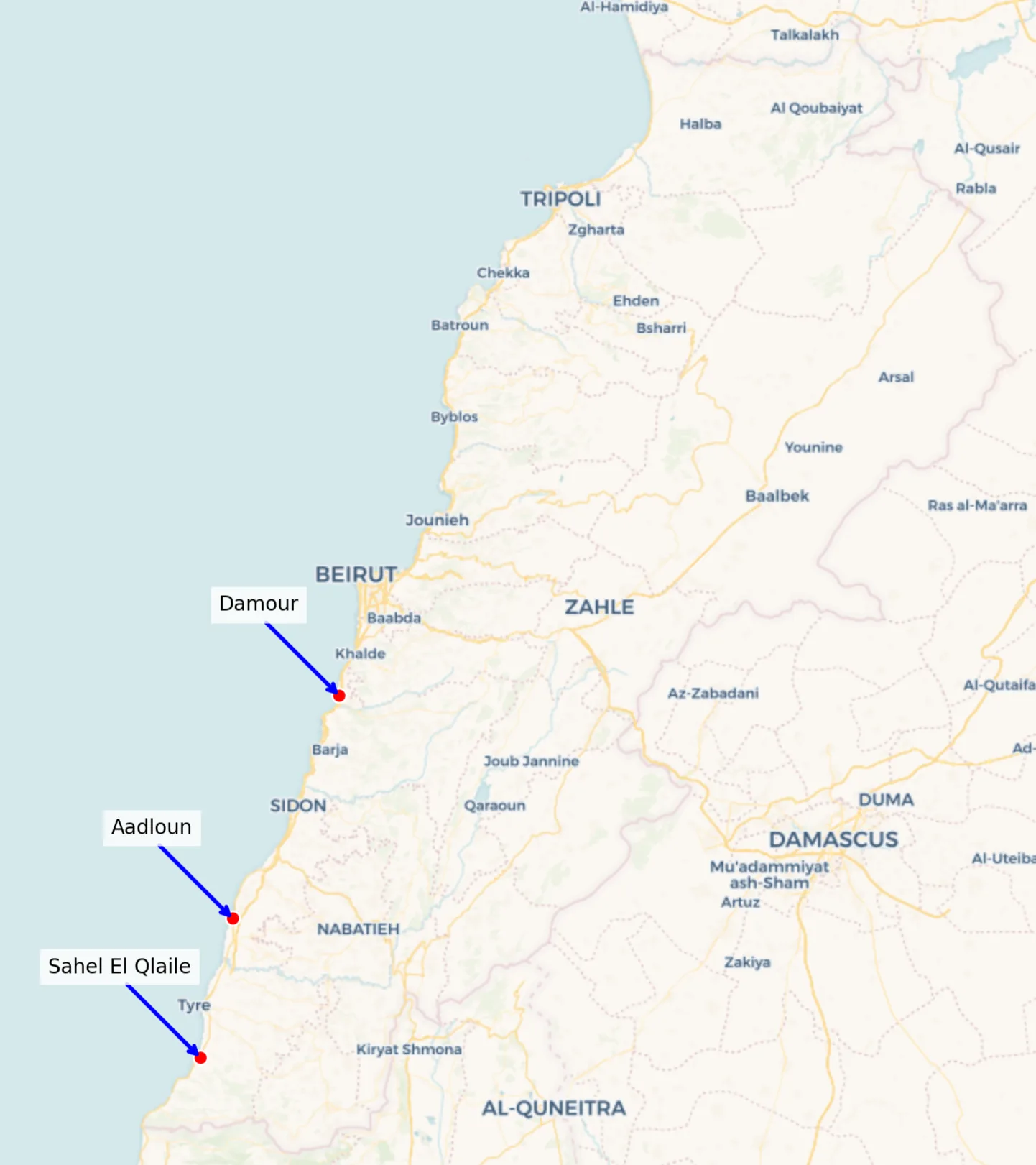
BananaSight was delivered under the EBRD Innovation Programme in Lebanon, for an agri-technology beneficiary working with Lebanese banana growers. Banana growing in Lebanon is restricted to frost-free coastal zones, so three representative areas of interest were selected along the coastal plain: Damour in Chouf, Aadloun south of Sidon, and Sahel El Qlaile near Sour. Together they span the core of the country's banana belt and a wide range of field size and management intensity, from Damour's fragmented plots averaging 0.23 hectares to Aadloun and Sahel El Qlaile, where fields average 0.77 and 0.87 hectares.
Building the dataset
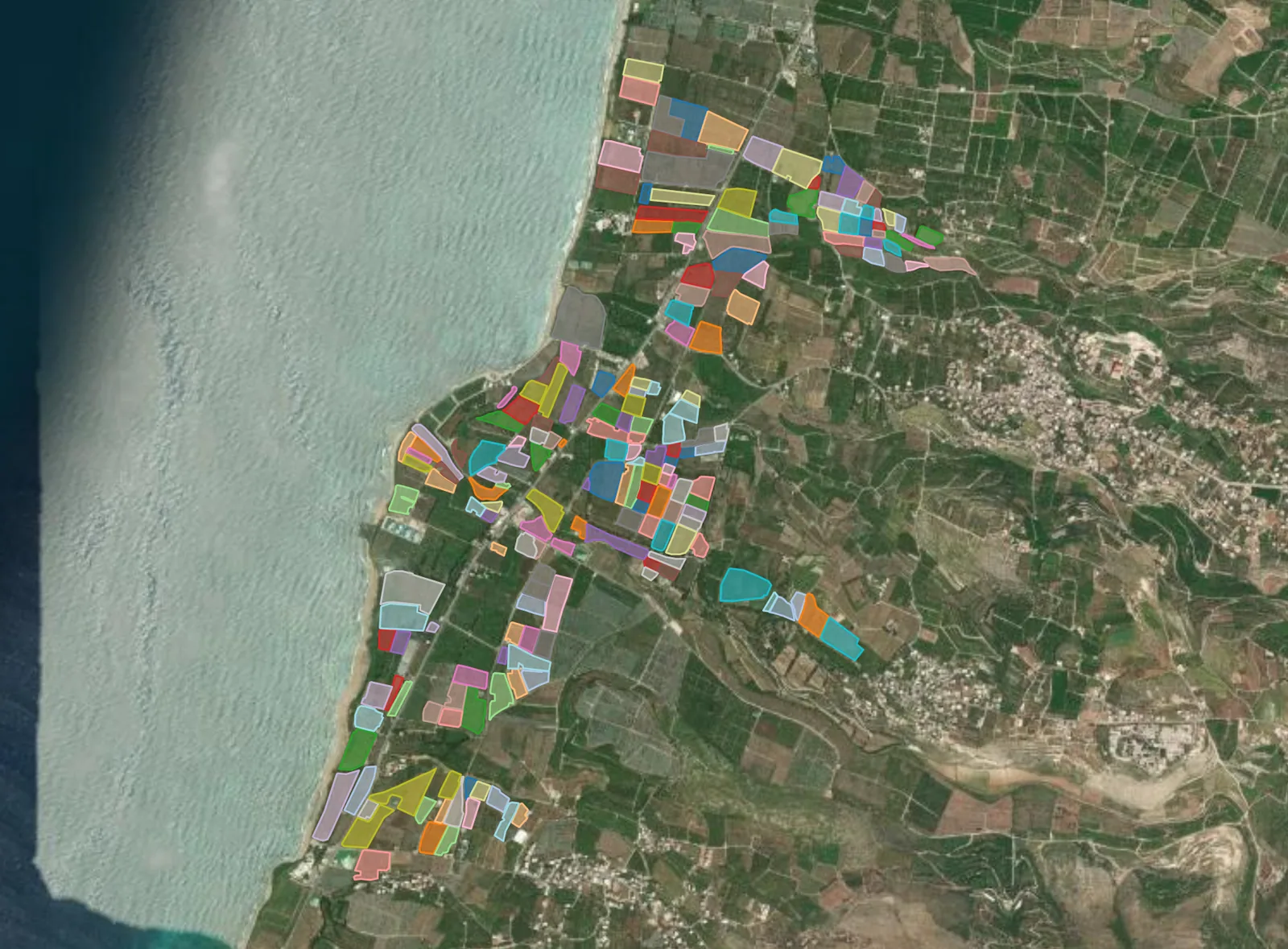
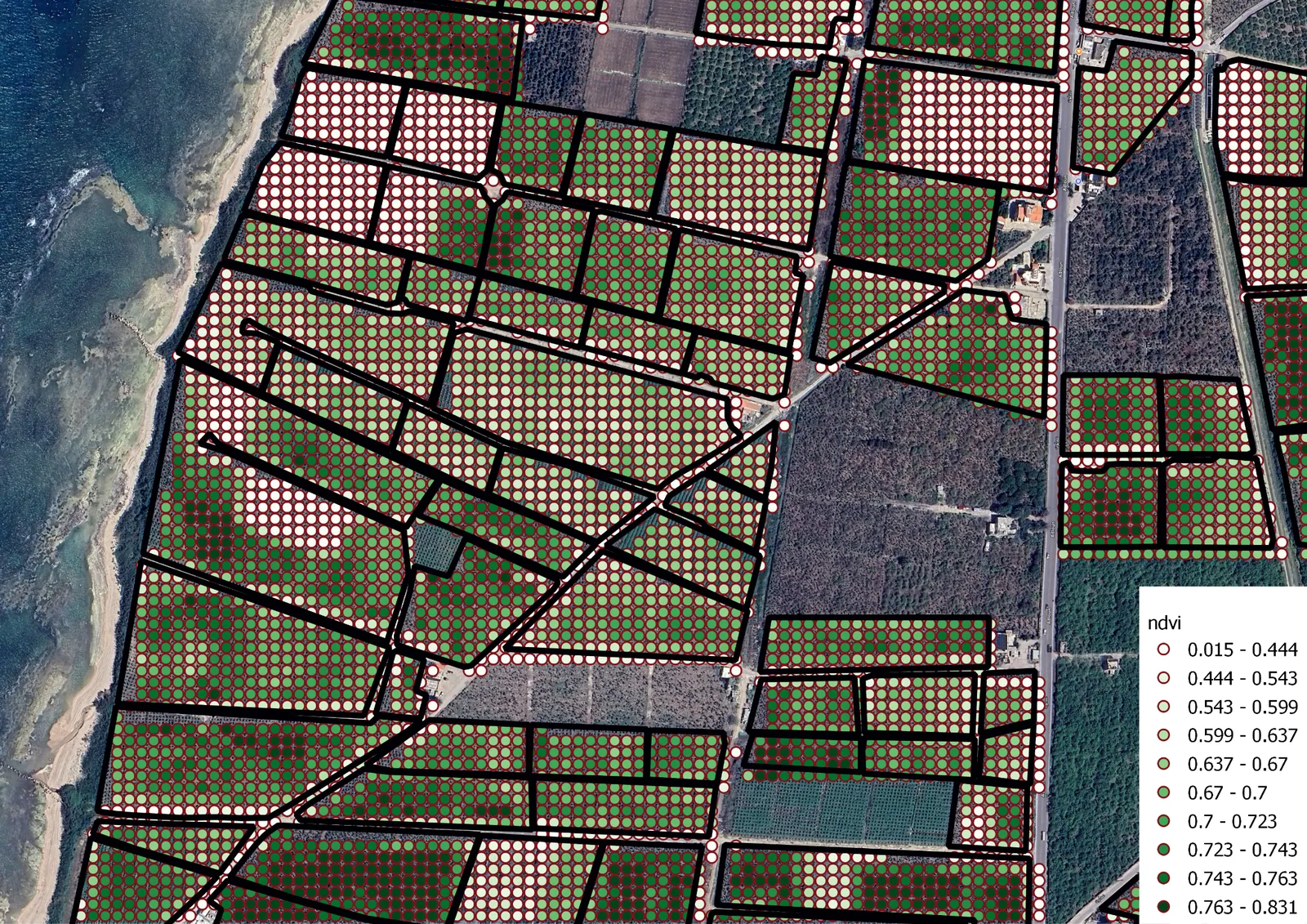
As far as the team could establish, no public dataset addressed TR4 symptom detection, so one had to be built. Field boundaries were digitised in QGIS from high-resolution basemaps and Street View, cross-checked against historical imagery to confirm consistent banana cultivation across several seasons, then validated by on-site survey and consultation with local farmers, producing 713 annotated banana fields covering 413 hectares. An automated pipeline assembled a four-year weekly Sentinel-2 time series over each area (2020 to 2024), using Level-1C products, retaining all 13 spectral bands and cloud masks, and selecting the least cloud-affected scene for each week. The result is a four-year weekly record for each of 42,000 georeferenced pixels (more than eight million pixel-week observations), with fourteen vegetation, soil and water-related indices computed on top of the raw bands, including NDVI, SAVI, NDWI, NDMI and BSI.
Learning the banana growth cycle
Detecting disease in bananas is harder than it first appears, because a healthy plantation's signal already rises and falls sharply through the year. In Lebanon the vegetative growth phase runs from April to September: NDVI climbs from around week 16 and declines between weeks 35 and 40 as mother plants are harvested and cut, while the bare soil index traces approximately the inverse. Since TR4 also depresses NDVI, an infected plant during the natural autumn decline looks much like a healthy one. The system therefore concentrates on the growth window, where a falling vegetation signal contradicts the expected seasonal rise and is far more likely to be genuine stress.
The approach
BananaSight forecasts what a healthy pixel should look like and flags the pixels that do not follow. A deep-learning time-series model is trained on the four-year archive to project the expected trajectory of each spectral index, and the observed satellite signal is compared against that expectation week by week. Deviations are interpreted per index (suppressed vegetation indices, bare-soil values rising towards positive, canopy moisture lower than expected) and combined into a pixel-level anomaly score, with separate vegetation, soil and water scores so an alert can be attributed to canopy condition, soil exposure or water content. Because the method is unsupervised it does not depend on a large library of labelled TR4 cases, and it flags any stress worth a grower's attention rather than TR4 alone.
Validation
The test set was assembled from three sources: two fields where the beneficiary had recorded TR4 in 2020; a farmer-guided survey near El Qlaile in which five infected and five healthy plants were confirmed on the ground; and further TR4 sites reported in the literature in China, Peru and Mozambique. On held-out data the forecasting model explained more than 88 per cent of the variance in the observed signal. Mapped anomaly scores were highest inside the parcel surveyed as diseased, while the surveyed healthy parcels stayed largely clear. At a second site, where the only available information was that TR4 was present somewhere in the field, the model localised the anomaly to the middle and upper-right sections, areas that visual inspection confirmed as reduced or wilted canopy.
From pipeline to product
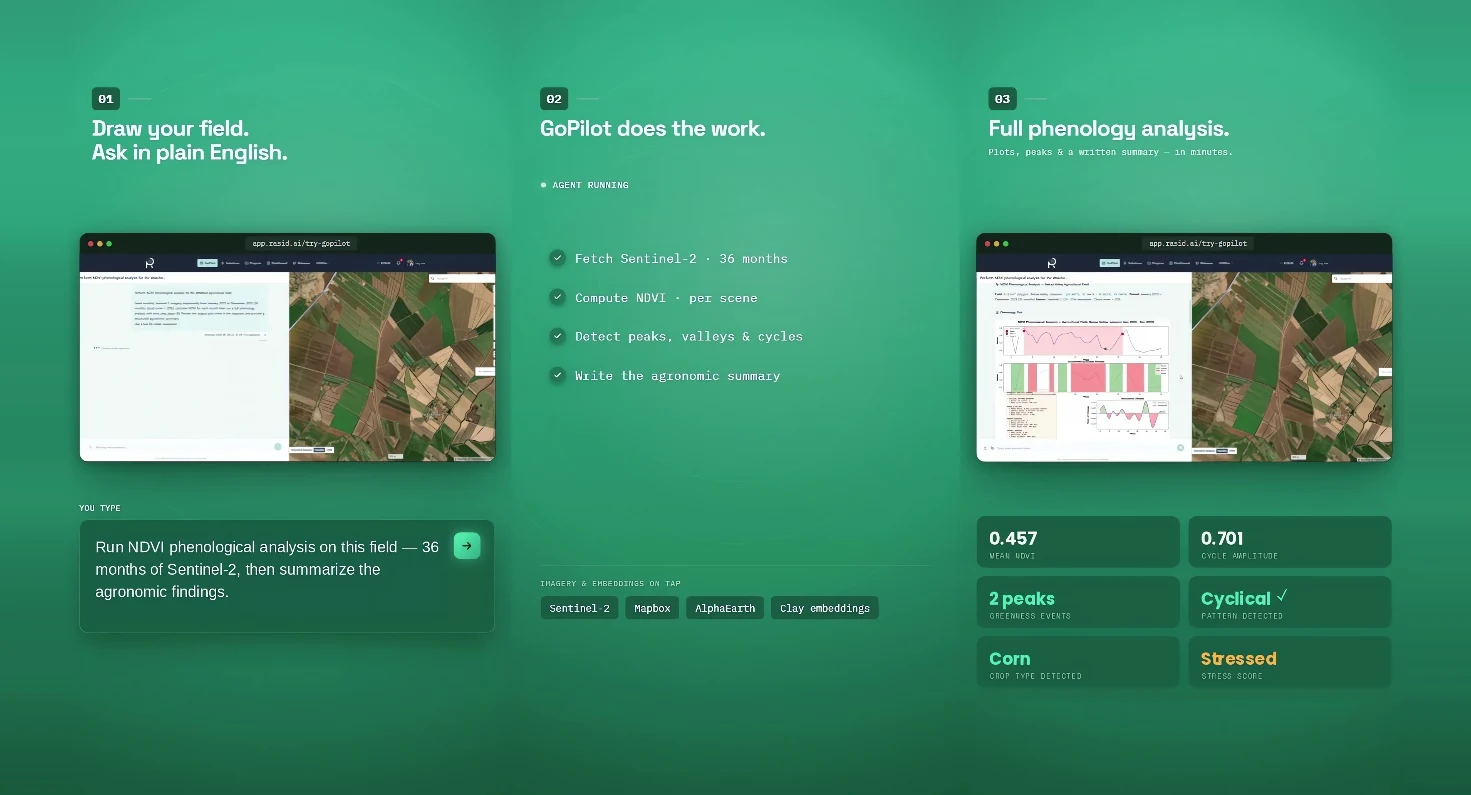
BananaSight was delivered as a web tool rather than a research script. A user creates a project, draws or uploads the field boundary as a polygon, selects the week to monitor and runs the model; the output is an anomaly heat map over the plot. The monitored week has to fall inside the April-to-September growth window, and because the tool reaches back through the Sentinel-2 archive to 2015, the same workflow can be pointed at past seasons to review how a field behaved before and after a known outbreak.
The result
The project produced an analysis-ready, multi-temporal Sentinel-2 dataset for banana monitoring, a validated stress-detection method, and a working interface the beneficiary can run on its own fields. The practical value for a grower is triage: instead of walking hundreds of hectares on a fixed schedule, inspection effort goes to the pixels diverging from the expected healthy cycle. The framework was built to be transferable to other banana-producing regions and, in principle, to other crops monitored with multispectral imagery. Detection lead time has not yet been measured against ground-confirmed infection dates; quantifying it is one aim of the planned next steps, which also include a full growing season of on-field validation, feeding that field feedback back into the model, and testing outside Lebanon.